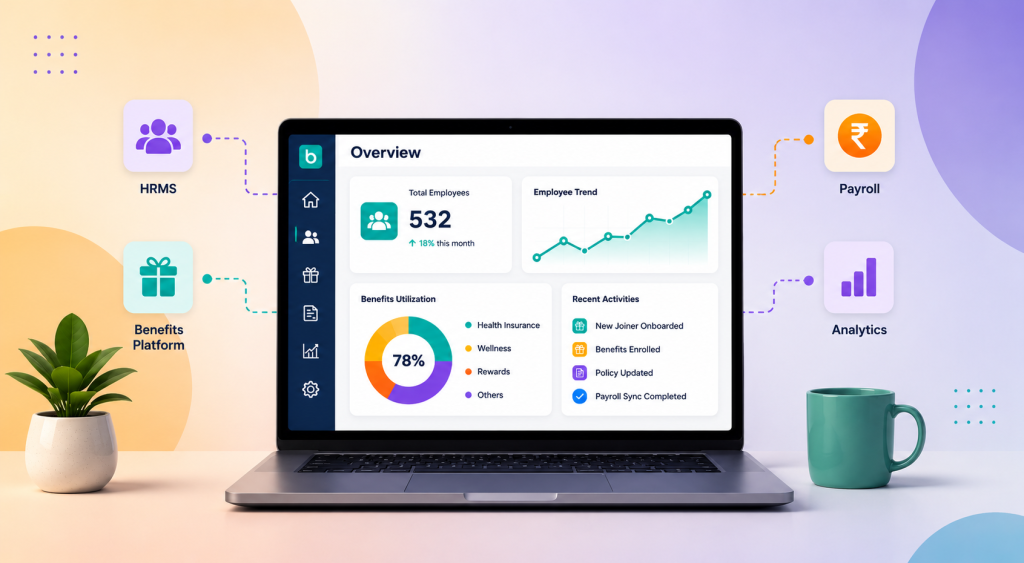
HRMS integration for benefits management means connecting your core HR system with your benefits platform so employee data flows automatically between the two. Without it, HR teams re-enter the same information across insurance, rewards, and payroll tools. In India, where mid-size companies often run three or more separate HR systems, this manual duplication adds up fast. A well-built HRMS integration removes that friction and keeps benefit eligibility accurate as employees join, move, or leave.
Why Disconnected HR Systems Cost More Than They Save
Manual data entry between systems creates errors that show up exactly when employees need benefits most.
- New joiners wait for access. Manual onboarding into a separate benefits system delays insurance and rewards activation.
- Exits aren’t reflected quickly. Former employees sometimes retain access to benefits for weeks after leaving.
- Role changes get missed. A promotion or transfer often does not automatically update benefit eligibility.
- Duplicate data entry wastes HR time. The same employee details get typed into three or four separate systems.
- Errors erode trust. Wrong salary or department data in the benefits system leads to incorrect insurance coverage or tax calculations.
What to Look for in an HRMS-Integrated Benefits Platform
The right integration should feel invisible to HR — updates happen automatically, without anyone lifting a finger.
- Broad HRMS compatibility. Look for a platform that connects with the specific HRMS your company already uses, not just the largest one or two.
- Real-time sync, not batch uploads. Changes to employee status should reflect within the benefits platform immediately, not overnight.
- Automatic onboarding and exit handling. Platforms like Benefitwise activate benefits the moment a new joiner is added in the HRMS, and deactivate access on exit.
- Role-based eligibility updates. Promotions and transfers should automatically adjust which benefits an employee can access.
- Single sign-on support. Employees should not need a separate login to check benefits if they already have HRMS or WhatsApp access.
- Data accuracy safeguards. Tools like Benefitwise flag mismatches between HRMS and benefits data instead of silently applying incorrect information.
- Minimal IT involvement after setup. Once integrated, HR should be able to manage benefits configuration without repeated IT requests.
Benefitwise brings all of this together — support for 76+ HRMS integrations, real-time sync, and automatic onboarding and exit handling. Explore Benefitwise →
HRMS Integration: What Good Looks Like vs What to Avoid
| Signal | Good integration | Weak integration |
|---|---|---|
| Data sync | Real-time, automatic | Manual uploads or batch files |
| Onboarding | Auto-activates benefits | Requires a separate HR step |
| Exits | Access removed instantly | Access lingers for weeks |
| IT dependency | Low after setup | Ongoing tickets required |
The Bottom Line on HRMS Integration for Benefits
HRMS integration is not a nice-to-have feature — it is what determines whether a benefits platform actually reduces HR workload or quietly adds to it. Companies that choose platforms with broad, real-time HRMS compatibility spend less time on admin and more time on strategy. Benefitwise’s 76+ HRMS integrations exist precisely to remove this friction, so benefit accuracy no longer depends on manual updates.
Look for broad HRMS compatibility, real-time data sync, and automatic handling of onboarding, exits, and role changes. A strong integration should reduce manual HR work, not create a new set of admin tasks. Platforms with 76+ HRMS integrations, like Benefitwise, are built specifically for this.
It keeps benefit eligibility accurate as employees join, change roles, or leave the company. Without integration, HR teams manually update multiple systems, which increases the risk of errors and delays in benefit access.
It can, but it usually means more manual data entry and a higher risk of outdated employee information. Over time, this becomes a significant time cost for HR teams, especially at companies with frequent hiring or role changes.
Benefitwise supports 76+ HRMS integrations, covering most systems used by mid-size and large Indian companies. This allows employee data to sync automatically instead of through manual uploads.
Good integrations require IT support mainly during initial setup. After that, HR should be able to manage day-to-day configuration and benefit changes without submitting repeated IT tickets.